
Can you Can in an Instant Pot
This page may contain affiliate links. More Information.
I understand why people would want to use an Instant Pot for canning, it’s convenient, right? But it’s just not a good option. Below, I’ll explain why (with sources), what might work instead, and how you can use your Instant Pot safely for other preserving methods. Water bath canning is a yes!
Before you click away!! Let’s talk about why. – Here’s a quick video that explains the basics. You can also scroll below to read the full article and see some extra details I didn’t include in the video. You might be surprised by what you learn!
I know this is not what most people want to hear. But…. My recommendation is Do not can in an instant pot. Not even the ones with the “canning” setting.
While instant pots are great for dinner prep, they are not approved for pressure canning low-acid foods. Below, I’ll explain why, what might work instead, and how you can use your Instant Pot safely for other preserving methods. Water bath canning is a yes!
Why People Want to Can with an Instant Pot
I totally get it. Pressure canners can feel intimidating. They’re big, they hiss, and they have gauges and plugs. Instant Pots, on the other hand, are sitting on your counter already. You use them all the time. They’re easy, familiar, and way less scary, right?
- Less intimidating than a traditional pressure canner
- A set-it-and-forget-it kind of appliance—no hovering over pressure gauges
- Already sitting on your kitchen counter
- Cheaper than buying a brand-new pressure canner. (sometimes)
- It says canning right on some models. (Did you know that the canning setting is no longer on newer models. The company retracted that.)
It’s easy to see why people think, “Why not just use this for canning too?” I thought about it myself! My Instant Pot doesn’t have the canning setting, but even if it did, I still wouldn’t use it for pressure canning.
Food Safety is the Dealbreaker
Pressure canning is about more than just sealing jars. It’s about killing dangerous bacteria like Clostridium botulinum. That only happens at very specific temperatures, held for a very specific amount of time—and that’s where the Instant Pot falls short.
Low-acid foods are the issue here. They need to reach 240–250°F at sea level and maintain that temperature long enough to kill harmful bacteria. That’s where an Instant Pot simply can’t keep up.
What Testing Shows About Instant Pots and Pressure Canning
Unlike many canning questions where we just say “it hasn’t been tested,” in this case, there has been testing done.
According to Utah State University Extension:
“The United States Department of Agriculture (USDA) has recommended against electric pressure cookers being used for canning, and now we have our own data showing that they just don’t hit the high temperature needed for canning safely at our altitudes.”
Source
But Mine Has a “Canning” Setting.
Yes, some models (like the Instant Pot Max) include a setting labeled “canning.” Instant Brands later removed that feature from newer models and no longer recommend canning.
Even Instant Pot Max’s own manual refers users to the USDA guidelines—which do not recommend electric pressure cookers for canning.
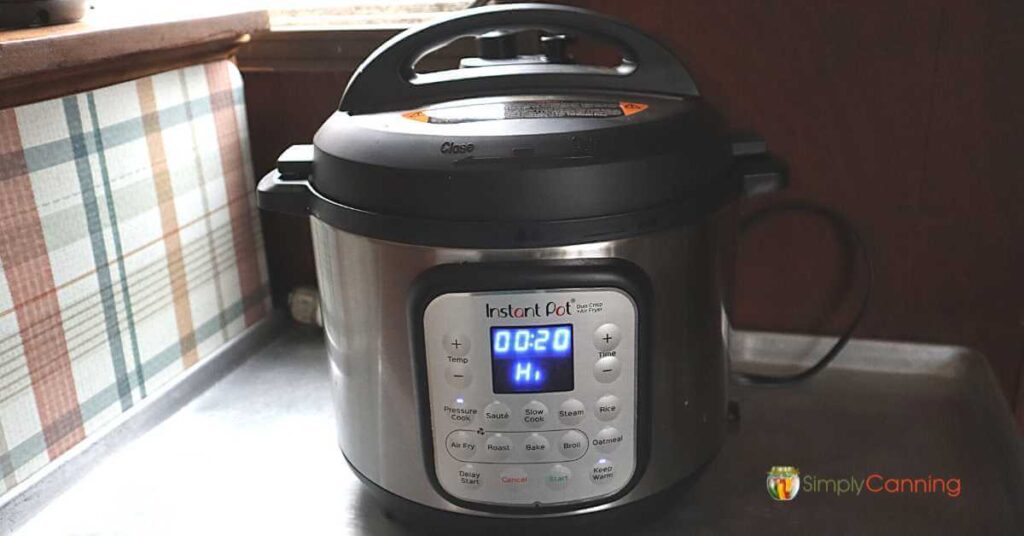
PLEASE NOTE: Even the instant pot Instant Pot Max with a canning feature is not suitable for pressure canning.
What About the Temperatures?
The Instant Pot’s own temperature graph shows:
- Initial heat up to 253°F
- But then cycling between 242°F and 239°F
Source
That drop to 239°F might not seem like much—but it matters. The temperature must stay above 240°F the entire time.
If your pressure dips, even for a moment, you’re supposed to restart the processing time. That’s impossible with an electric appliance that cycles automatically.
So, even if your pot hits the right temp for a moment, it doesn’t maintain it—which means it doesn’t meet USDA safety guidelines.
Why home “tests” aren’t proof of safety
You might see popular videos where people “test” pressure cookers or Instant Pots. These tests can be interesting to watch and give a sense of how the equipment works—but it’s important to understand what they actually show. Home tests usually involve just a few jars, and the food isn’t intentionally spiked with botulinum spores, the bacteria that causes botulism.
Official canning guidelines, on the other hand, rely on controlled lab testing with many jars that are deliberately inoculated with botulism spores. This allows scientists to measure whether the process consistently destroys the bacteria under worst-case conditions. And it is done MANY times.
So, while home testing videos can be fun to watch, they don’t replace official, tested methods when it comes to protecting yourself from botulism.
What about the presto pressure canner?
This is a completely different tool. It is not fully tested yet… but it is apparently in process and it is looking good. It might be a good option for those who are intimidated by stove top canners. Check here for more information on the Presto electric pressure canner. I’ll update that post if/when official testing comes out.
What About Water Bath Canning?
Here’s where we get a little good news. You can sometimes use an Instant Pot for water bath canning, but only if all the conditions are met.
Requirements for water bath canning:
- A rack or trivet on the bottom to elevate the jars
- Enough depth to cover jars with 1–2 inches of boiling water
- Ability to maintain a consistent rolling boil for the entire processing time
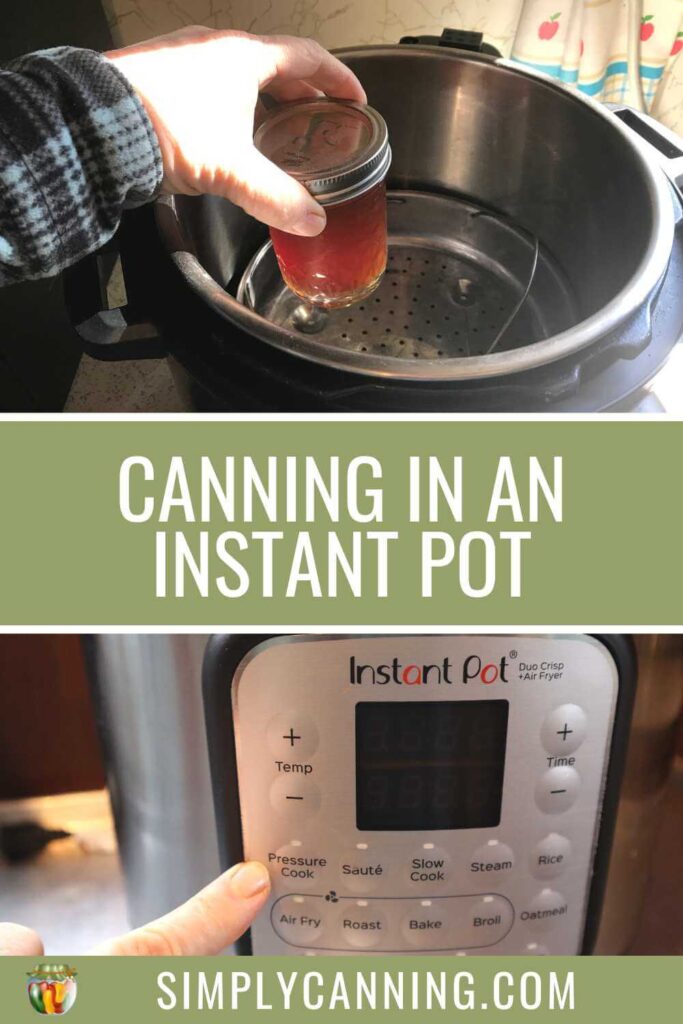
I tested my Instant Pot Duo Crisp Air Fryer model using two small jelly jars—8 oz and 2 oz. Pint jars were too tall, but the smaller ones fit, and I could get the required water depth.
I used the Sauté function and brought the water to a nice rolling boil, which it maintained for 10 minutes without cycling off.
So yes—small-batch water bath canning is possible in some Instant Pot models. But each model is different. You’ll need to test yours to make sure it meets all three criteria.
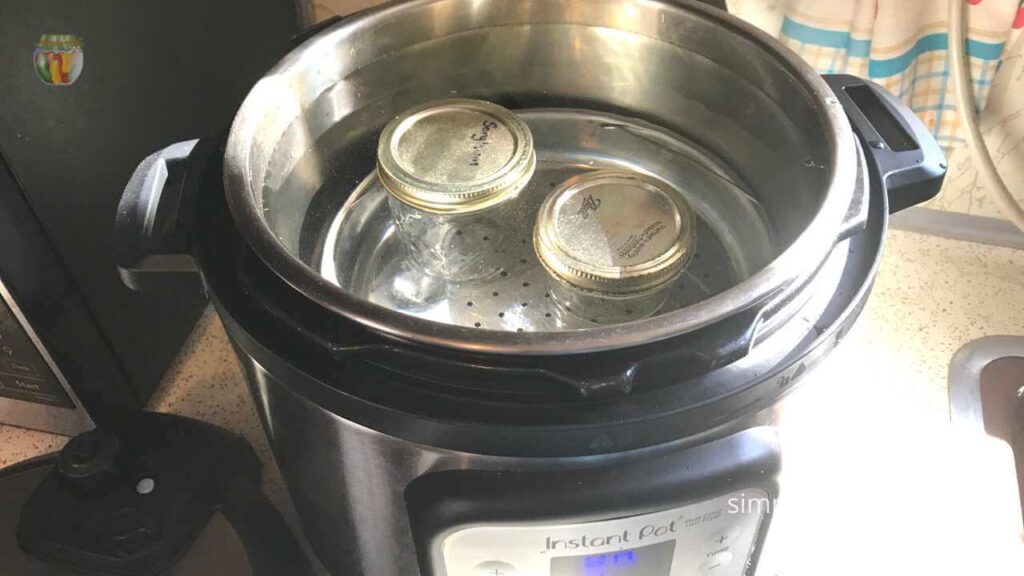
Tips for Using an Instant Pot for Water Bath Canning
- Don’t seal the lid—leave it off or set it slightly ajar.
- Use only for high-acid foods like jams, jellies, and fruit.
- Make sure your jars are completely covered in boiling water.
Honestly? In most cases, a good old-fashioned stockpot is easier.
Why People Want to Use the Instant Pot for Canning
They are intimidated. Pressure canners look scary. Big bulky pots. They hiss. Pressure valves. Dials. Gaskets. PRESSURE.
Get to know your equipment, and your fear will melt away. I’ve got a full article that breaks down all the parts of a pressure canner and how it works—because knowledge conquers fear.
I want to encourage you: They come with all kinds of safety features. You can get dial-gauge or weighted-gauge models.
They all have a pressure safety valve (I call it the mighty plug in my Pressure Canning Confidence course!).
Here’s a Quick Start Guide I created for Pressure Canning.
But I’ve already go it.
You already have an Instant Pot. So why not use it? I know it’s tempting. But honestly, it’s just not worth the risk. Here are some ideas on finding a reasonably priced pressure canner.
- See if a friend or family member has a pressure canner collecting dust.
- Check thrift stores or online marketplaces.
- Let people know you’re looking—you’d be surprised what turns up.
Final Word: Instant Pot Is for Cooking, Not Canning
The Instant Pot is fantastic for making soups, stews, and roasts quickly. I use mine all the time. But when it comes to home food preservation, it simply doesn’t meet the safety standards we need.
Stick to approved methods. Get yourself a good pressure canner. And rest easy knowing that your canned goods are safely processed.
Quick Summary…Can You Can in an Instant Pot?
- No, you cannot safely pressure can in an Instant Pot—even if it has a “canning” setting.
- Testing shows these appliances don’t reach or maintain USDA-recommended temperatures for safe canning. The temperatures fluctuate during processing and this is not acceptable.
- Instant Brands (the company that puts out instant pots) once offered a model with a Canning button but later retracted it.
- Some models might be suitable water bath canning. This depends on your model size and function. See more below on how to use your instant pot for water bath canning.
FAQ
To my knowledge the USDA does NOT test specific brands of pressure canners. They offer advice for safely processing. The testing done that is mentioned in this article was on electric pressure cookers. The Instant Pot is simply a brand of electric pressure cooker.
Not at this time. This Presto Electric Pressure Canner is a promising candidate, click here to read my thoughts, you might be pleased. As of now, no electric pressure canner or cooker is USDA-approved. Hopefully that changes someday!
If you have an older Instant Pot Max, it might have a Canning button. But even Instant Brands has clarified this is only for high-acid foods—and it still doesn’t maintain safe temps. Best to skip it
Resources & Further Reading
- USDA Guide to Food Preservation Temperatures
- Utah State University Extension on Electric Pressure Cookers
- Instant Pot Technology Overview
- Instant Pot Max Owner’s Manual
- NCHFP Electric Cooker Fact Sheet
It is understandable that electric pressure cooker canning would provoke skepticism but apparently Presto makes one that follows USDA guidelines. I guess what I don’t understand is that while the default skepticism for the Instant Pot Max arose from the fact that nobody understood how the Instant Pot developers tested it and none of the independent associations had examined it’s performance, it went from “We can’t recommend it because we haven’t tested it” to “We can’t recommend it because it’s electric” to “We can’t recommend it because it’s an Instant Pot Max and those aren’t safe”. I have searched high… Read more »
Thank you for a nice civil discussion on this topic. :). Interesting how some of your points leads me to a different conclusion. My narrative on the subject was ‘can’t recommend it because it hasn’t been tested‘ to ‘can’t recommend it because testing showed some problems‘. If the testing showed that it worked… then it doesn’t matter what the brand is or if it is electric or not. The process must work. I would say that pulling the product would indicate that maybe Instant pot realized that they had potential issues with canning. But they would not put a statement… Read more »
P.S. – for those stubborn abt using these for pressure canning and think, “oh, well, temperature is closecenough,” pressure canning requires a minimum 15psi (pressure) where as the Duo Nova is only rated up to 12 psi.
You’re mixing apples and oranges. Nobody is talking about pressure canning in a 12 PSI pressure cooker, which describes over 98 percent of the Instant Pot line. IP clearly reserves the “canning” button for pressure cooker models they say can reach 15 PSI. Those include the discontinued Max model and a PRO model.
Beyond fear, there’s another reason. Newer stoves are glass-topped/convection heat. I have both my grandmother’s & mother-in-law’s old OLD HEAVY pressure canners, & treasure both. But with their own wt., combined with weight of water & filled jars,it’s a disaster lurking. Even lightweight stock pots (which makes the process dreadfully slow) is unadvised by manufacturers. The 21st century woman finds herself surrounded by flashy gadgets that impede self-sufficiency (Apologies to any men who enjoy canning). I don’t pressure can anymore, as I find the taste of frozen better (of no use in an apocalypse, ofcourse. Then again, most likely, neither… Read more »
I completely agree. However, pressure canning still has its place for those who grow gardens or fruit trees and don’t want to allow a bumper crop to go to waste. Canning is not just about surviving the apocalypse. (Most of those glass jars would break anyhow following an epic disaster.)
Makes soo much sense, thank you for this article!