
Steam Canner: Types, Comparisons, and How to Choose
This page may contain affiliate links. More Information.
There are different styles of steam canners, different claims, and more than a few forum posts arguing about whether any of it is even safe. I’ll go over what’s actually been tested, the two main styles of steam canners you’ll find, and how to pick one that fits your kitchen.
Are you looking for step-by-step instructions? This page covers equipment: what to buy, is it safe, and why. Check this Steam Canning Start Here Guide for full how-to and first project ideas.
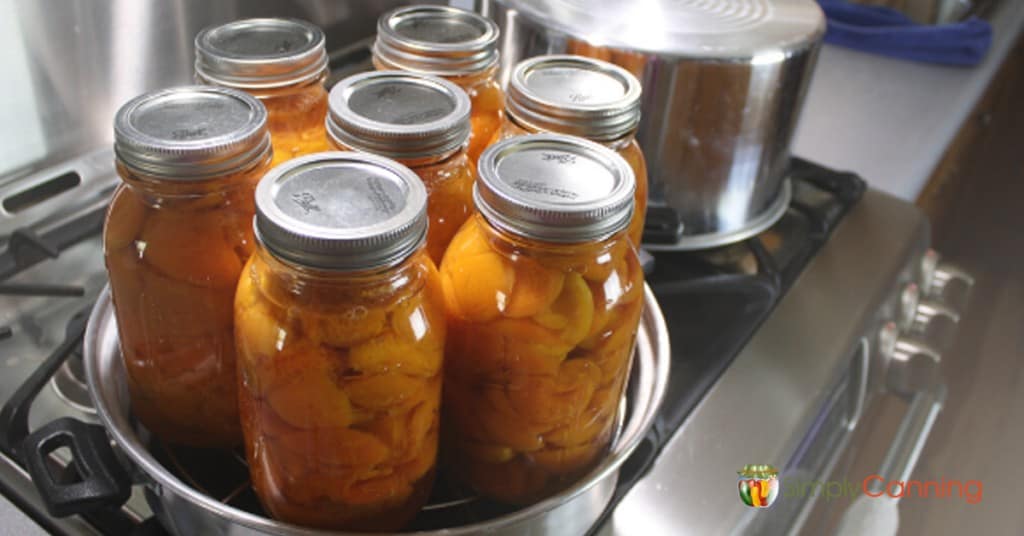
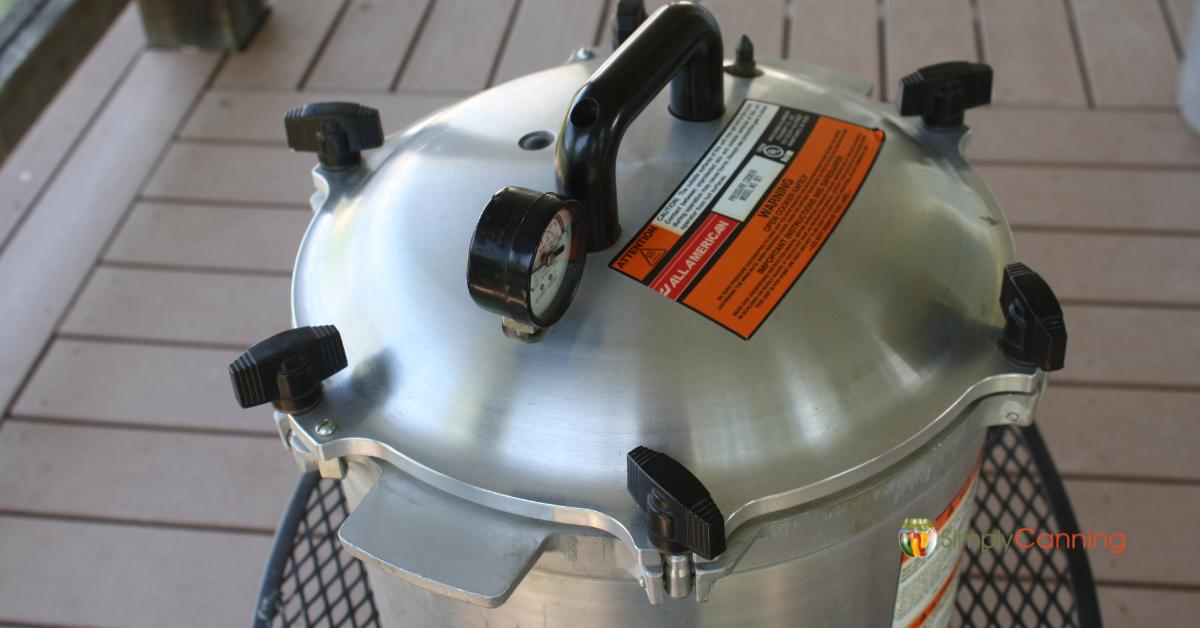
Remember there are 3 types of canners used for processing either high acid or low acid foods.
- Pressure canners – used for meats and vegetables. (low acid foods)
- Waterbath canners – used for most fruits, jam and jellies, and pickled items. (high acid foods)
- Steam canners – also used for most fruits, jam and jellies, and pickled items. (high acid foods)
What a Steam Canner is (and what it isn’t)
Steam canners work a lot like water bath canners—they’re both for high-acid foods—but there are some differences:
- Instead of submerging jars in boiling water, steam canners use steam to heat and process the jars.
- They use much less water, usually about a quart and a half, compared to up to four gallons for a full water bath. That makes heating faster and handling jars much easier.
Just to be clear: a steam canner is not a pressure canner, and it doesn’t do a pressure canner’s job. Sometimes people say “steam pressure canning” when referring to pressure canning. But this is not what I’m talking about. Don’t confuse steam canning with pressure canning.
Steam Canner vs. Water Bath Canner
A steam canner works as an alternative for a water bath canner, for the same category of foods. (High acid)The biggest difference is the amount of water and the style of canner. A water bath canner needs enough water to fully submerge jars. A steam canner only needs water in the bottom of the canner, just enough to boil and keep producing steam.
Once you’re actually processing, though, the two methods use the same processing times, from the same tested recipes.
Is Steam Canning Safe?
Steam canning has gotten a lot more attention over the past few years, but it’s a method that has been around for many years.
Even with all the anecdotal stories of success that I kept finding online, and all the seeming benefits, I never plunged into steam canning. I’m so picky with my concern over canning safety I really wanted to find that official testing. (I know it drives some people crazy. That’s ok we can agree to disagree on some things.)
I decided to wait. I had heard that it was being tested so I waited…. and waited… and waited. I finally found the research that I’d been waiting for. (More on the testing history and details below) Steam canning is tested, it is safe. I tried it. I love it! No question about it.
Interestingly, the testing did not include the recipes and booklet that come with the canners. It may sound strange but even though the process and a few specific canners have been tested, the recipes in the steam canner’s included instruction booklet was not. If you choose to use a steam canner go with USDA approved and tested recipes.
Two Styles of Steam Canners
There are 2 styles of steam canners. One has a shallow base with a tall domed lid. The other looks like a large stock pot with a temperature gauge in the lid.
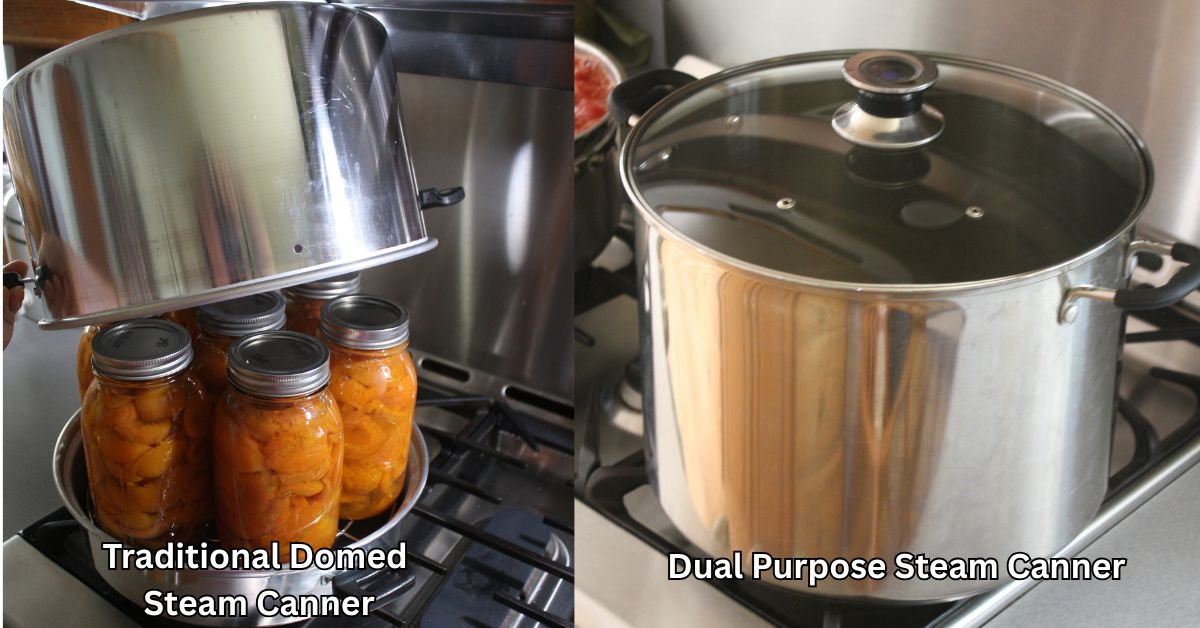
Traditional Domed Style (Steam Canning Only)
This is the traditional steam canner that they used for the testing process. It has a shallow base with a rack and a tall domed lid with vents on the side. Those vents are important. When the canner is up to temperature you’ll notice a strong stream of steam coming from the vents. That steam needs to continue throughout the processing time. (More details on the how to use a steam canner post.)
Dual-Use Style (Both Steam and Water Bath Canning)
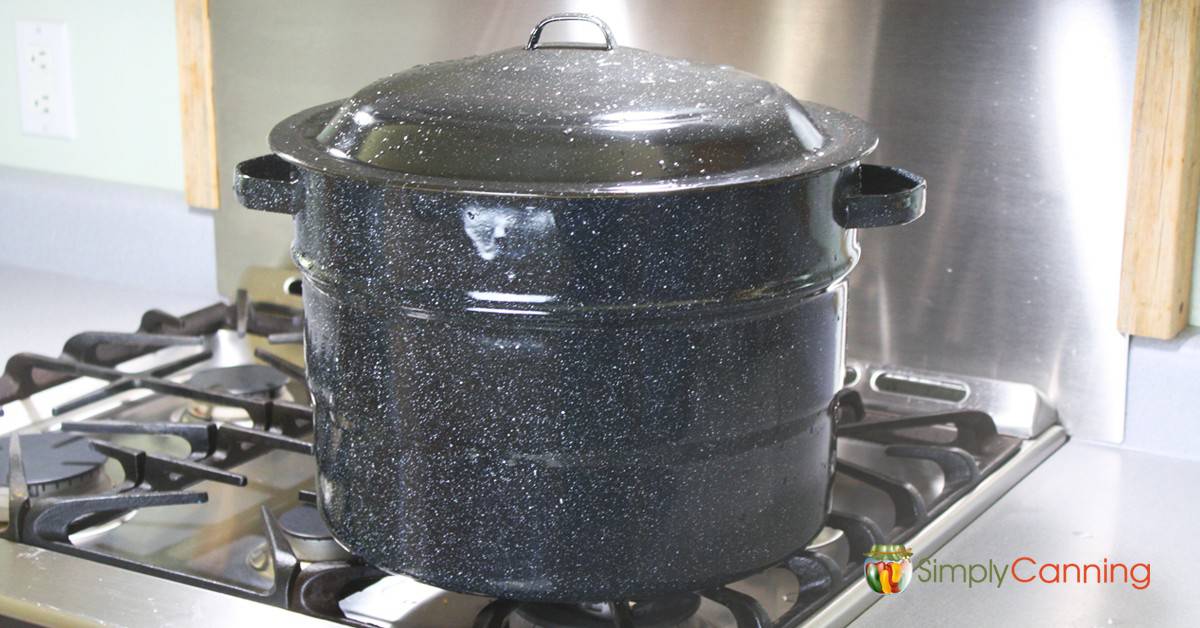
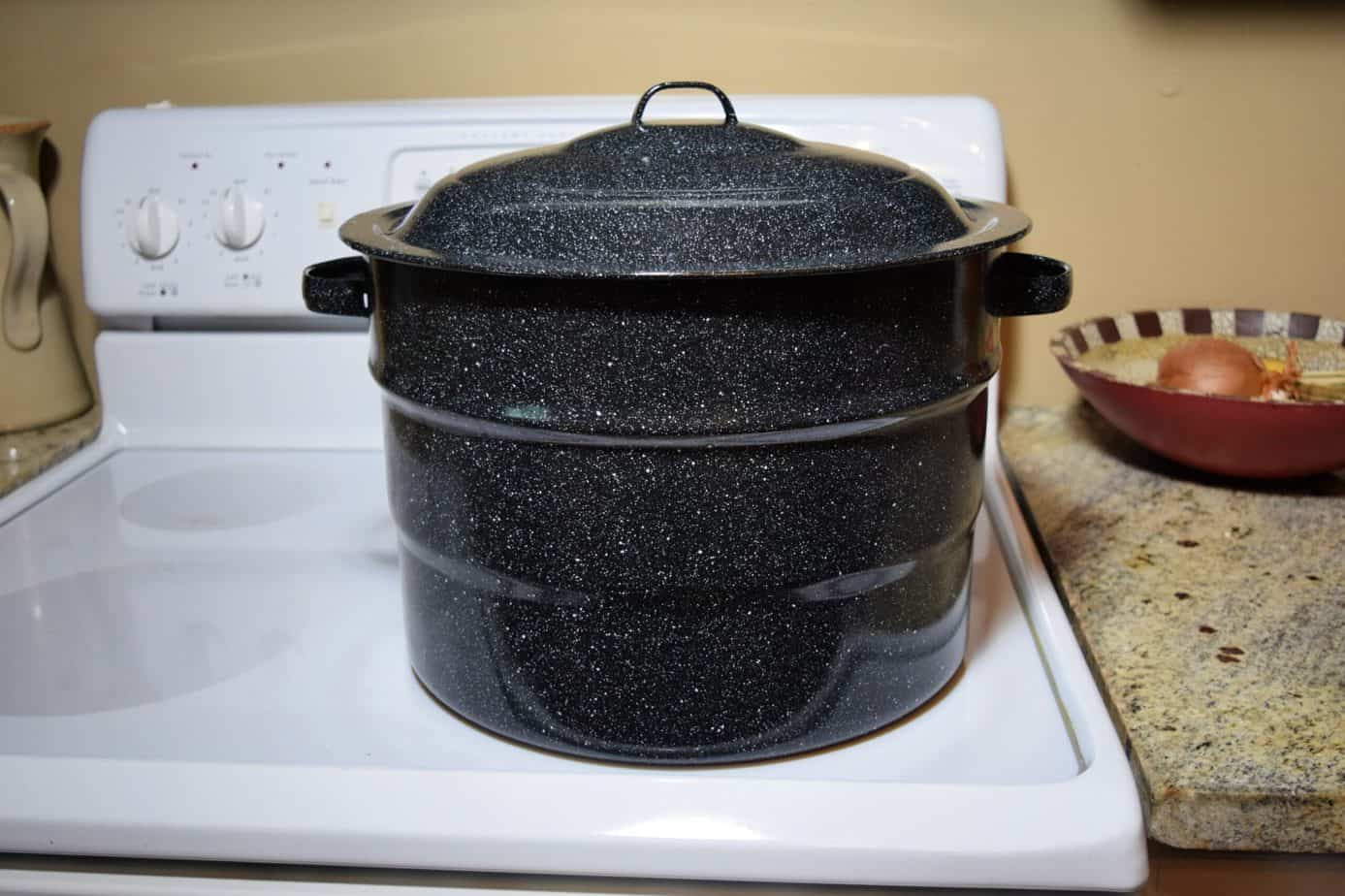
There is also a stainless steel water bath canner that has a thermometer in the lid handle and a vent hole. This pot doubles as both a water bath or a steam canner. If you don’t want to store two separate canners, this solves that — and the pot doubles as a plain stockpot.
Dual use is the style I have. Both styles work but my kitchen is crowded enough without adding equipment I can only use for one thing. “One pot, two jobs” is very useful if space is tight in your kitchen too.
The catch is…. The dual use canner has not been clearly tested. It’s a bit vague.
Let me be clear, the method itself (steam canning) has been tested as safe. The domed lid canners have been tested as working appropriately for the method. The dual use canner is not tested although it has been mentioned in publications that it ‘appears to work’.
I did a bunch of research on this and it has a rather complicated paper trail. I’ve got all the resources I could find at the end of this article if you want to search it out for yourself. It boils down to this.
- The dual use canner was not a part of the original 2015 lab research,[1] This testing was only done on the dome lid style. And only the Back to Basics and Victorio brands were tested.
- A 2017 University of California extension publication included the dual use canner alongside the tested designs.[2] This document includes a description of the dual use canner and clearly states it can be used for safe steam canning. (This is when I started using the canner). ADD IMAGE HERE
- In 2019, a publication addressed other canner styles directly, describing the physics that make a design likely to work.[3] In this publication Barb Ingham states “At least one other type of steam canner has vent holes in the top of the lid and, properly vented, this model appears to work; check with a thermometer in the vent hole to make sure the temperature is ~212 degrees.” I am making the assumption that she is referring to the dual use canner. She stops short of saying the dual use is tested. But doesn’t state that it is unsafe. Just says “appears to work”
- By 2020, Wisconsin’s follow-up guidance (authored by Barb Ingham) narrowed things to specifically recommend against adapting a boiling-water-canner-style pot for steam use,[4] stating specifically because it has not been tested they can ‘make no recommendation’.
- The most recent document I can find is a 2022 document [5] authored by Barbara Ingham , alongside specialists from NDSU, Iowa State, Kansas State, and Nebraska extension. So it appears several people conferred and agreed on the information included. It States that the canner has not been tested and refers you to “check back with the manufacturer for instructions on safely using other styles of steam canners.” They do not explicitly say it is not safe. Just check with the manufacturer. That to me is a much softer stance.
Should you use a Dual Use Steam Canner?
I’ll tell you honestly: I use mine and I’m comfortable with it. But if any bit of uncertainty makes you second-guess yourself before you even start: buy the dome-style canner instead.
Confidence matters here — if you’re going to actually get in the kitchen and do the project instead of leaving the canner in the box while you worry about it, starting with a clean uncomplicated choice is worth the peace of mind.
Links to Buy a Steam Canner
Back to Basics Steam Canner
I borrowed one of these to try it myself. It’s the traditional domed style — a shallow base with a tall vented lid — and one of the two brands actually used in the original 2015 lab research on steam canning safety. Since it’s steam-only, you’ll still want a separate water bath or pressure canner for low-acid foods.
Check current price on Amazon →
Kitchen Crop FruitSaver Aluminum Steam Canner
Another traditional domed-style canner, same mechanism as the Back to Basics model above. I haven’t personally tested this one, but it’s worth knowing: this appears to be the current version of the Victorio-brand canner used in that same 2015 research — the manufacturer has sold the same model under the Victorio, FruitSaver, and Kitchen Crop names over the years so it gets a little confusing.
Check current price on Amazon →
Victorio Stainless Steel Multi-Use Canner (VKP1130)
This is the one I actually use. It works as both a water bath canner and a steam canner, so I’m not storing two big pots in my kitchen. I like having tyhe temperature gauge in the lid. It takes the guesswork out of knowing when you’ve hit the right temperature. One thing to know: this is the dual-use style, which wasn’t part of the original testing — see the research breakdown above if that matters to you.
Check current price on Amazon →
Can You Convert Other Canners Into a Steam Canner?
Two versions of this question come up.
Can I use my regular water bath canner as a steam canner?
No. A standard water bath canner is designed to fully submerge jars in boiling water — it doesn’t have the vented dome lid (or the temperature gauge of the dual use canner) that a steam canner needs to actually produce and hold steam correctly.
Can I use my pressure canner as a steam canner?
I wouldn’t. I know it seems like it should work. But it is not tested and there may be issues. It looks like it “should work” isn’t the same thing as research confirming it does work. If you want to steam can, a canner actually built for that job is the safer route.
Is steam canning or water bath canning better?
Steam canning is not ‘better’ than water bath canning. They are just 2 different methods that do the same thing. Either works for the proper foods. It is just personal preference.
Is Steam Canning Tested and Approved?
I mentioned this above but with the information about the canners themselves I want to be sure it isn’t mixed up in your mind. The method of steam canning is tested as safe. No problem there.
Steam canning has the National Center for Home Food Preservation’s approval, laid out on their Burning Issue page: “atmospheric steam canners are approved for high-acid or properly acidified foods, with a pH of 4.6 or below, as long as specific critical controls are followed.”
Critical controls just means that you need to remember two things. And they are pretty easy.
- Steam canning is hot pack only.
- Processing time can’t exceed 45 minutes, altitude adjustments included.
Note: many of the USDA canning guides still have language indicating that steam canning is not currently recommended. They have not been updated (obviously if you have a physical book it won’t be.) but the method has been tested and approved when it is done according to guidelines.
Here is a link to the step by step how to use a steam canner post again.
Frequently Asked Questions
No. Steam canners are best for high-acid foods like fruits, jams, jellies, and pickles. If you’re canning vegetables, meats, or soups, you’ll need a pressure canner to keep everything safe.
The big perks are that it uses less water, heats up faster, and is lighter to handle.
At higher elevations, some recipes will need a little extra time. If that pushes your processing past 45 minutes, you need to use a traditional water bath canner instead of steam.
Yes, if you’re canning high-acid foods. A properly used steam canner works fine. Just follow the instructions carefully and make sure you see a steady stream of steam before starting your timer.
Nope! You can use the same canning jars and lids. Just double-check that they’re free of chips or cracks, and follow your canner’s instructions for sealing.
Absolutely! Steam canners are very beginner-friendly for high-acid foods. The trick is to follow directions carefully, watch the steam level, and avoid foods that need long processing times. You’ll get the hang of it quickly.
Research Sources
As of the update of this page, all these links work. Extensions and edu sites are known for moving pages around.
- Willmore, P., Etzel, M., Andress, E., and Ingham, B. “Home Processing of Acid Foods in Atmospheric Steam and Boiling Water Canners.” Food Protection Trends 35, no. 3 (2015): 150–160.
- Harris, L.J. and Soule, K.E. “Guidelines for Safe Canning of Acid Foods in a Steam Canner.” University of California Agriculture and Natural Resources, Publication 8573, September 2017. https://ucanr.edu/sites/default/files/2017-10/271172.pdf
- Ingham, B. “Your Questions Answered: Steam Canning.” Extension Winnebago County, August 26, 2019. https://winnebago.extension.wisc.edu/2019/08/26/your-questions-answered-steam-canning/
- “An Update on Safe Use of Steam Canners.” Extension Winnebago County, August 24, 2020. https://winnebago.extension.wisc.edu/2020/08/24/an-update-on-safe-use-of-steam-canners/
- Ingham, B., Garden-Robinson, J., Geiger, M., Blakeslee, K., West, R., and Larvick, C. “Steam Can It Right! Guidelines for Safely Using a Steam Canner for Home Food Preservation.” North Central Food Safety Extension Network, FN2065, October 2022. https://www.ncrfsma.org/files/page/files/fn2065_steam_can_it_right_fillable.pdf
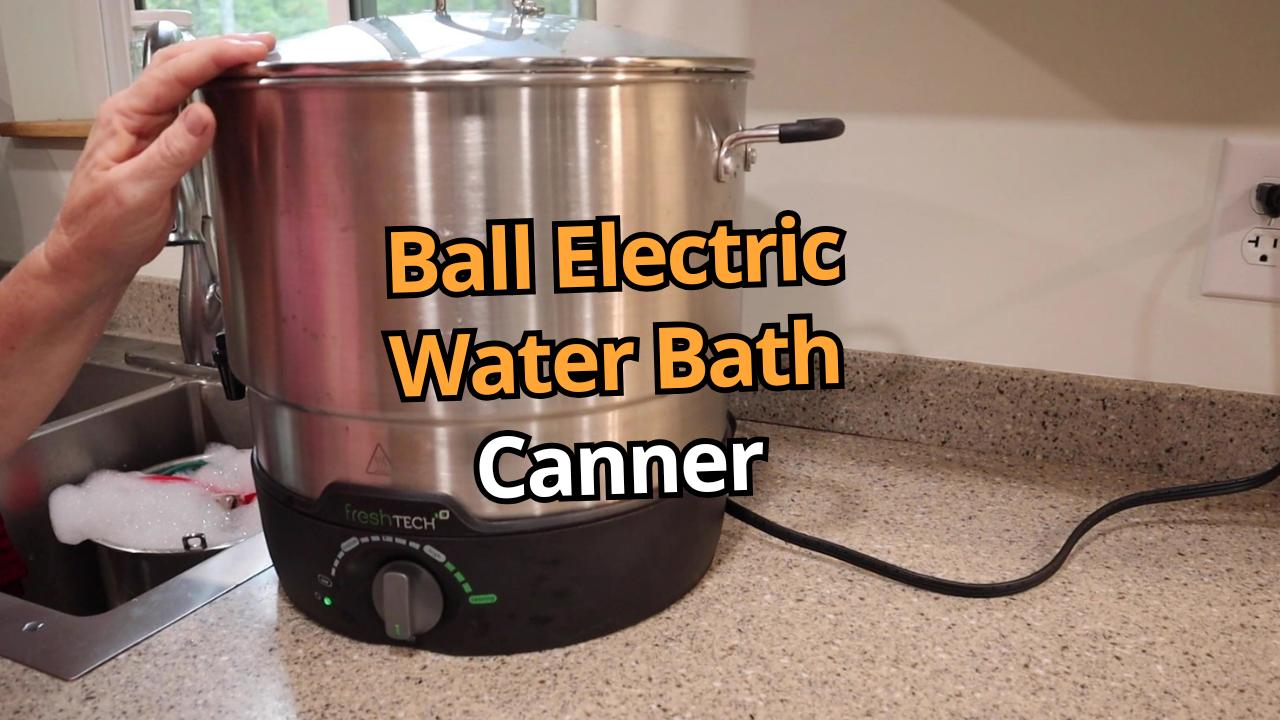
Kathy had asked a simple question, “could a water bath canner be used as a steam canner?” An answer was given on something else to read, without answering how someone could convert a water bath canner to a steam canner. So, my question is, “what needs to be done to convert a water bath canner to a steam bath canner?”
Hi Trish, I looked for Kathy’s question but I don’t see it. Maybe it is on a different article? But to answer your question, a regular water bath can not be converted to a steam canner. There are 2 styles of steam canners (see the article above) One of these styles can be used for both water bath and steam canning. It is a deep pot so you can submerge your jars for a water bath, but it also has a vent and a thermometer in the lid that shows altitude adjustments. A regular canner doesn’t have either of these… Read more »
In your article about steam canning, when you click on the Steam Canner, it brings you to a Water Bath canner, NOT a steam canner.
What steam canner would you recommend and where to purchase it?
Thank you for your incredible and resourceful website
Hi Cyndi. I double checked the links on that post and they both lead to a canner that doubles as both a steam canner and a water bath. Sorry if that was not clear. Here is a link to a steam / water bath canner combination on Amazon.
Can I use my pressure canner as a steam canner? I would leave the weight off and just let it vent the steam.
I can not recommend doing this as it has not been tested. You’d have to know what temperatures are being reached in your canner.
I have used nothing but a steam canner the last 30 years. Never a problem. So much easier and cleaner. Love my pressure canner too.
I’m not clear on what this means: “Remember: 1- Used tested recipes for any water bath appropriate food that is processed LESS than 45 minutes. ” Could you please expand on that or clarify? Thanks!
Hi Robbin, With the steam canner there is much less water than a full waterbath. If the time needed for processing is longer than 45 minutes, there is a risk of running the canner dry. That would not be a good thing for your food (it would be under processed) or the canner (it might warp.). Thanks for asking I’ll try to clarify that in the article above.
I haven’t canned anything yet but reading about the steam canner vs water bath and pressure. One of my interests is to can tomato sauce and salsa…can that be done in a steam canner?
Hi Kari, One of the conditions of using a steam canner is that the processing time must be 45 minutes or less including any altitude adjustments. So it really depends on the recipe you are using and your altitude. In my case, I live at a high altitude which requires added time and some tomato directions for me require 45 minutes or more. Some recipes I can steam canner, some I can not. So check your directions and processing time.