
Canning Fish: Salmon, Blue, Mackerel, Trout
This page may contain affiliate links. More Information.
Ever wanted to try canning fish? I don’t really care for most fish. But salmon?!? Oh, we love salmon!
The NCFHFP site states that this recipe works for “Blue, Mackerel, Salmon, Steelhead, Trout, and other Fatty Fish Except Tuna“. I’m not familiar with all types of fish so I can’t say what “other fatty fish’ would include but the ones listed are all great.
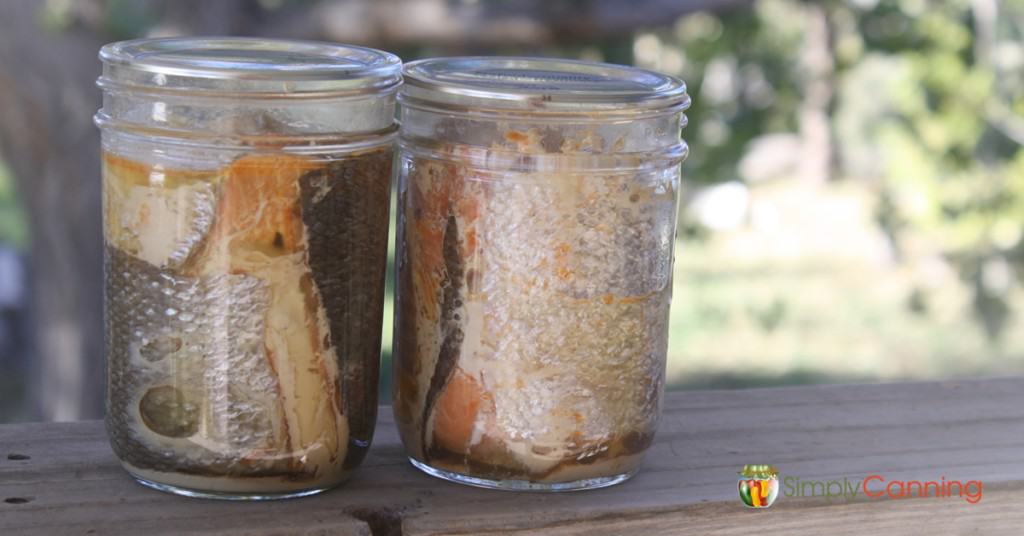

Remember, canning fish is just like canning meat. You will need to know how to use a how to use a pressure canner for canning fish.
Canning Fish:
Fish must be prepared in 1/2 pints or pints. If you want to can fish in quart jars, there are extra steps you must take, which I don’t cover here. (Check NCHFP and Alaska Extension for instructions.)
Personally, I’ve found that a pint of fish is a lot, so it’s more convenient to can in 1/2 pints. If you think about it, the cans of fish you buy in the store are often small. But of course, it all depends on how you use it in recipes.
Gather your canning supplies:
- pressure canner
- canning jars
- canning lids and rings
- jar lifter and canning funnel
- stock pot
- bowls
- large spoons
- sharp knife
- towels and dish cloths
Ingredients:
- fish
- canning salt
First, clean and prepare your fish.
- Remove the head, tail, internal organs, and all fins and scales.
- Wash well and split fish lengthwise.
- Cut fish into jar-length pieces if needed. You’ll pack the fish vertically in jars with an inch headspace.
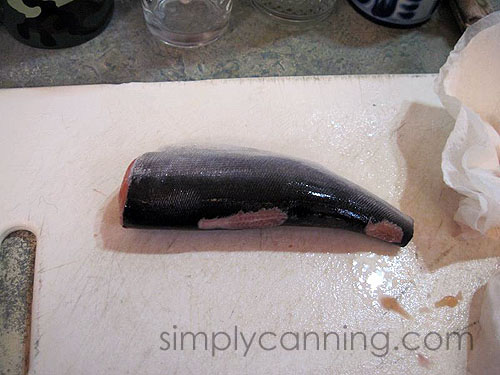
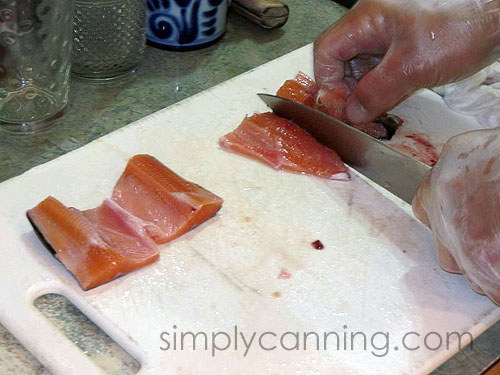
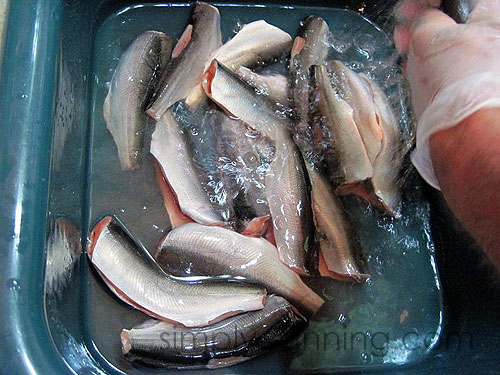
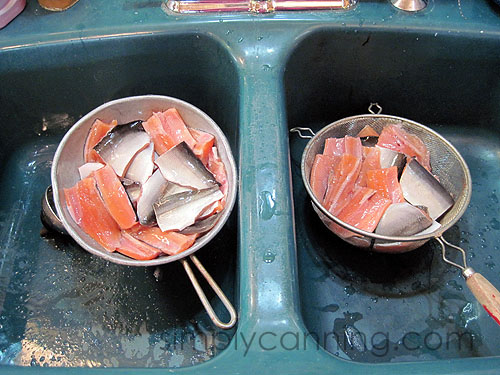
A big thank you to Susan, who graciously offered to take pictures of her canning fish sessions.
Soak your fish in a salty brine for 1 hour. Use 1 cup of salt to 1 gallon of water. This technique came from my Ball Blue Book, and I would think that brining would be especially helpful for flavor if the fish is fresh caught.
If you don’t brine, add salt to your jars if desired (1 tsp. per pint or 1/2 tsp. per half-pint).
Canning Fish
While fish is soaking in brine, gather all canning supplies needed. Start your water heating in your canner.
I’ve got instructions below but if you need more details see if you need more details see pressure canning with a printable checklist.
Drain fish for 10 minutes. You want to be sure it is well drained. You can rinse if desired.
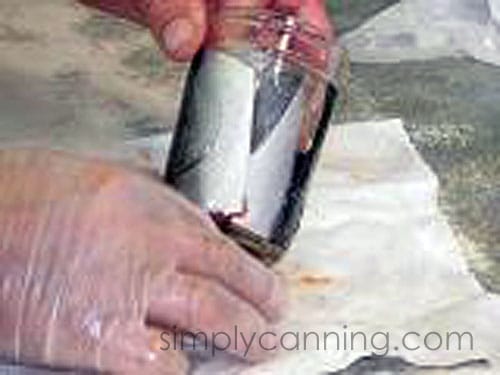
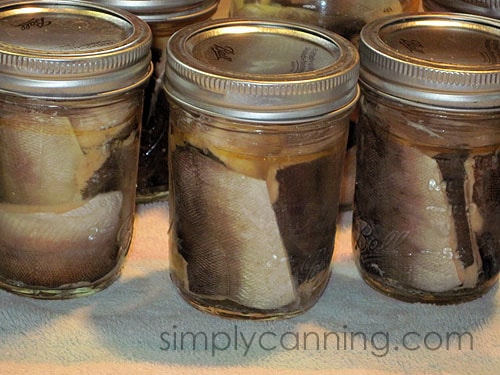
Pack fish into hot jars (pints or half pint jars), try to keep the skin side out next to the glass. This may be imperfect… it’s ok. Leave a 1-inch headspace. Do not add liquid.
Place lids and process according to the instructions below.
How Long Does It Take to Can Fish?
Process pints or half pints 1 hour 40 minutes.
Don’t forget to adjust for your altitude. Use the chart below:
Recipe Card
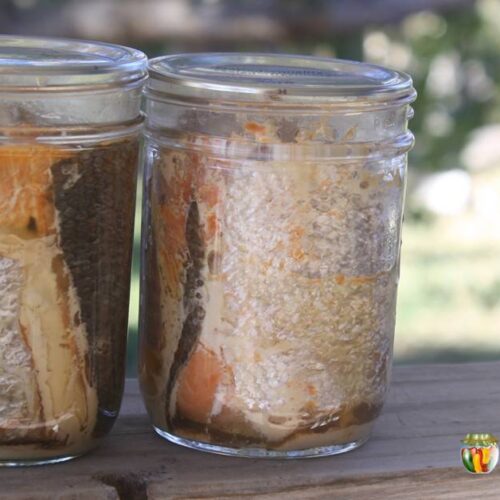
Canning Fish
Equipment
Ingredients
- Fish
- Canning Salt optional
Instructions
- Start by preparing your jars and getting water in the canner heating. You want the canner hot, but not boiling, when the jars are ready to be processed. If you are new to using a pressure canner, see this article for full pressure canning instructions. This includes more detailed information and step-by-step instructions on how a pressure canner works.
For a Raw Pack
- Clean fish, removing head, tail, fins, and scales. (Or purchase pre-cleaned fish.)
- Wash well and cut fish into jar-length pieces.
- Soak fresh fish in salty brine. (Optional. Use 1 cup salt to 1 gallon water.)
- Drain fish for 10 minutes.
- Pack fish into hot jar, putting skin sides next to glass and leaving 1” headspace. (If you didn't brine the fish, you can add 1 tsp. salt per pint or 1/2 tsp. salt per half pint.)
- Wipe the rim clean and place on your seal and ring. Place the jar in the warm canner. Proceed to fill all jars. Process according to below directions.
Notes
Adapted from: The National Center for Home Food Preservation, Ball Blue Book, Michigan State Extension
Canning Fish FAQs & Tips
Fish is a low-acid food and must be pressure canned to be safe. There are no safe recommendations for water bath canning fish, even if the jars seal.
According to the National Center for Home Food Preservation (NCHFP), tested instructions are available for: Salmon, Trout, Steelhead, Blue fish, Mackerel, Other fatty fish
These instructions do not apply to tuna, which requires different handling.
Use home canned fish the same way you would commercially canned fish— in sandwiches, salads, casseroles, spreads, or any recipe calling for canned fish.
Yes. Canning smoked fish is very similar to canning fresh fish. But there are a few differences. It must be smoked partially and then canned. I’ve got more on how to smoke and can fish on this post.
It’s generally suggested to use all home canned food within a year. But don’t toss your food after that 1 year mark. Just make a point to use it up soon. Quality and nutritional value starts to suffer after a year, but the food is still good.
Pin This to Find Later:
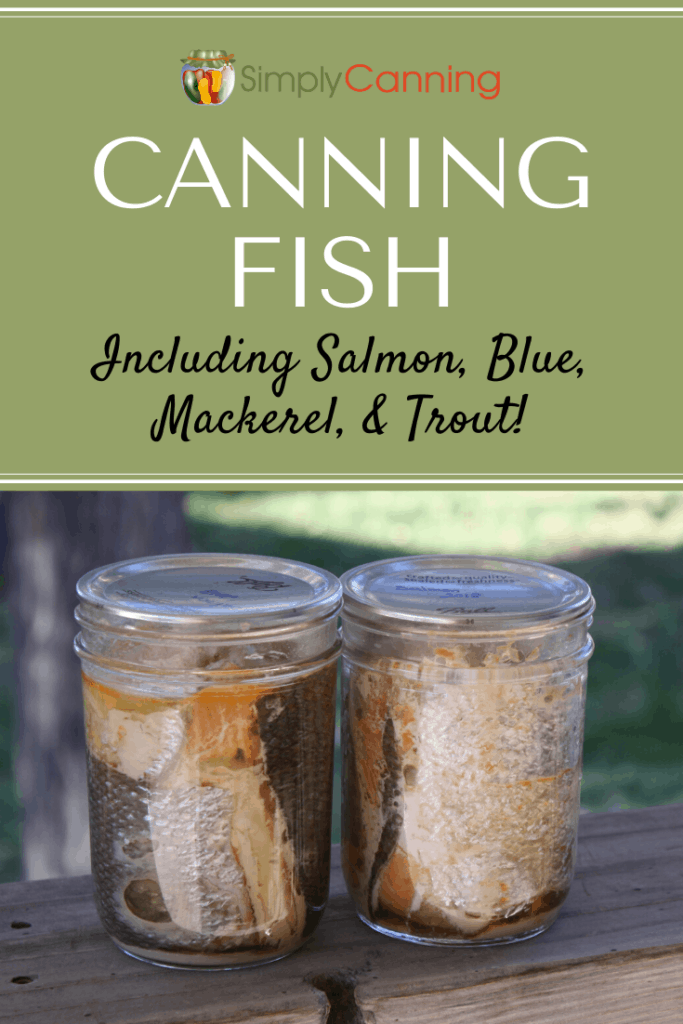
Source: The National Center for Home Food Preservation, Ball Blue Book, Michigan State Extension

Every winter once the lakes freeze over, we go ice fishing for trout & kokanee (often described as landlocked salmon species). We fillet them once home and freezer pack them. Come spring when the ice is no longer stable – it’s time to smoke and can them! We defrost the fish fillets, lay them in pans separated by type and then cover with demerara sugar & pickling salt mixture where they are left in cool temp area to brine over a set time period. Then we rinse them off, pat dry and set into smokers. Once they come out of… Read more »
can you pressure can alaskan pollock ? if so how
So, I’m not a fish expert. Is pollock considered a ‘fatty fish’? The NCFHFP site states that this recipe works for “Blue, Mackerel, Salmon, Steelhead, Trout, and other Fatty Fish Except Tuna“. I’m not familiar with all types of fish so I can’t say what “other fatty fish’ would include but the ones listed are all great.
Why do you put the skin side of fish next to the glass?
Firstly, my sources say it is best.🙂 Things I noticed in doing it this way: Some of the pieces will nestle in the jar with the skins inside other pieces. So not ‘all’ of the skin will be against glass. Just do your best to arrange them skin sides out.
It seems to make it easier to peel the skins off later. It looks nicer in the jar 😉. Having the fish sort of curved inwards with the meat to the inside keeps the flesh more together for texture.
Is there no liquid involved when canning fish? I see it says to add fish to jars skin side out, wipe down jar, then add rings and lids.
Often times when canning raw meat you don’t add liquid. The meat itself provides juices as it is processed.
This may be a stupid question, but can this recipe be used to can catfish?
BTW I used this recipe from you to can rainbow trout that I caught my first time fishing for trout! I was able to can 32 trout and freeze 16 (this was from fishing every weekend for a month.) Your resources have been an absolute Godsend as I learn to can the safe way!
Not a stupid question at all. Different types of fish meat vary so they all need to be considered individually. The sources I use all say “blue, mackerel, salmon, steelhead, trout and other fatty fish except tuna.” Now I’m not a fish expert so I don’t know if catfish is considered a ‘fatty fish’. But I’ve found 2 resources that do include catfish in the list. https://www.freshpreserving.com/blog?cid=fish-pressure-canning
https://extension.sdstate.edu/canning-fish
I hope that helps!
You might want to call you extension service and see if they can help
Roughly how many pounds of salmon do you need to fill 9 pints? Thank you for including those clues in the canning chicken recipe. Doing that today.
Hi, Dawn!
I checked the original recipe source, and they don’t list an amount either… I’m checking with Sharon to see if she has any idea!
-Rachel (Sharon’s assistant)
when placing in the jar ,make sure the skin is not touching jar,makes it way easier to wash jar after use
That sounds like a good idea. But by putting the skins out (towards the jar) makes the skin peel off easily when you prepare the fish to use. I like to remove the skins for our meals.
Why can you not can tuna?
Tuna may be canned, just not with this recipe. There are separate instructions for canning tuna at NCHFP: https://nchfp.uga.edu/how/can_05/tuna.html
-Rachel (Sharon’s assistant)
Oh, ok, wonderful, thank you!!
Can I process/can frozen fish after thawing? or should it be fresh?
Yes, you can! Extensions say this: “If the fish is frozen, thaw it in the refrigerator before canning.”
-Rachel (Sharon’s assistant)
Ok, dumb question. On one of those “Alaska” shows I saw how they cured(brined), smoked then canned their salmon. I smoke the majority of my fall salmon catch every year. Could I take some of the cold-smoked “lox” style I make and than some of that?
Not a dumb question at all! Actually, there are specific things you’ll need to do when canning smoked fish that are different than this recipe. One of those is smoking it in a specific way. I don’t have experience myself but I asked for help from a friend who does this himself. Go to this page for information on canning smoked salmon.