
Canning Tomatoes in a Pressure Canner
This page may contain affiliate links. More Information.
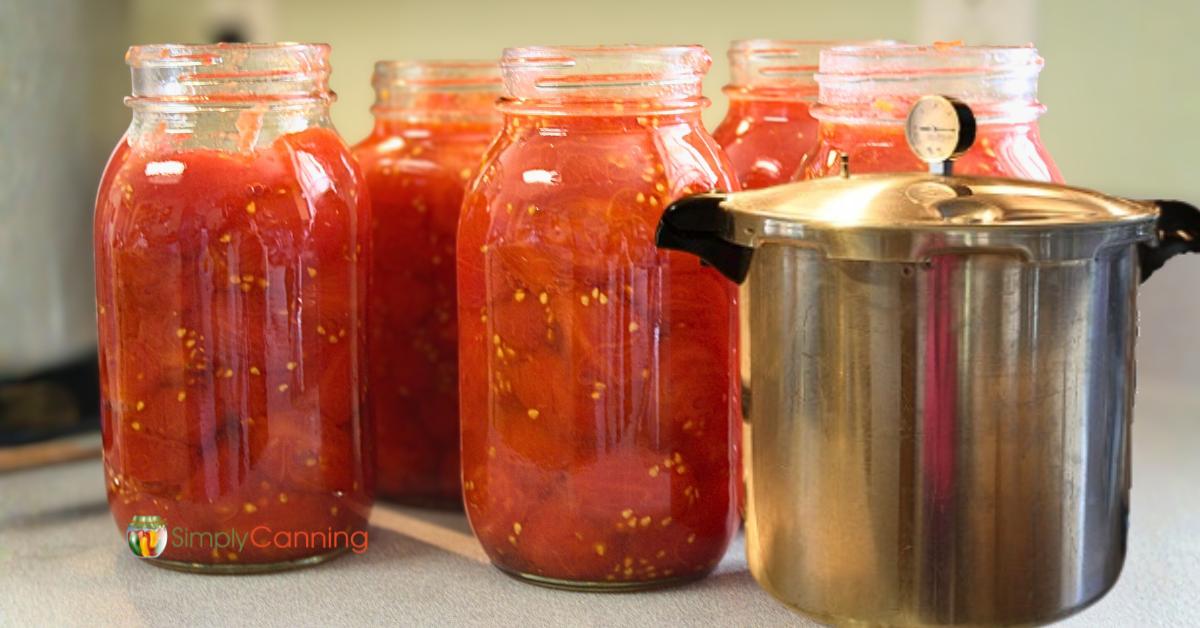
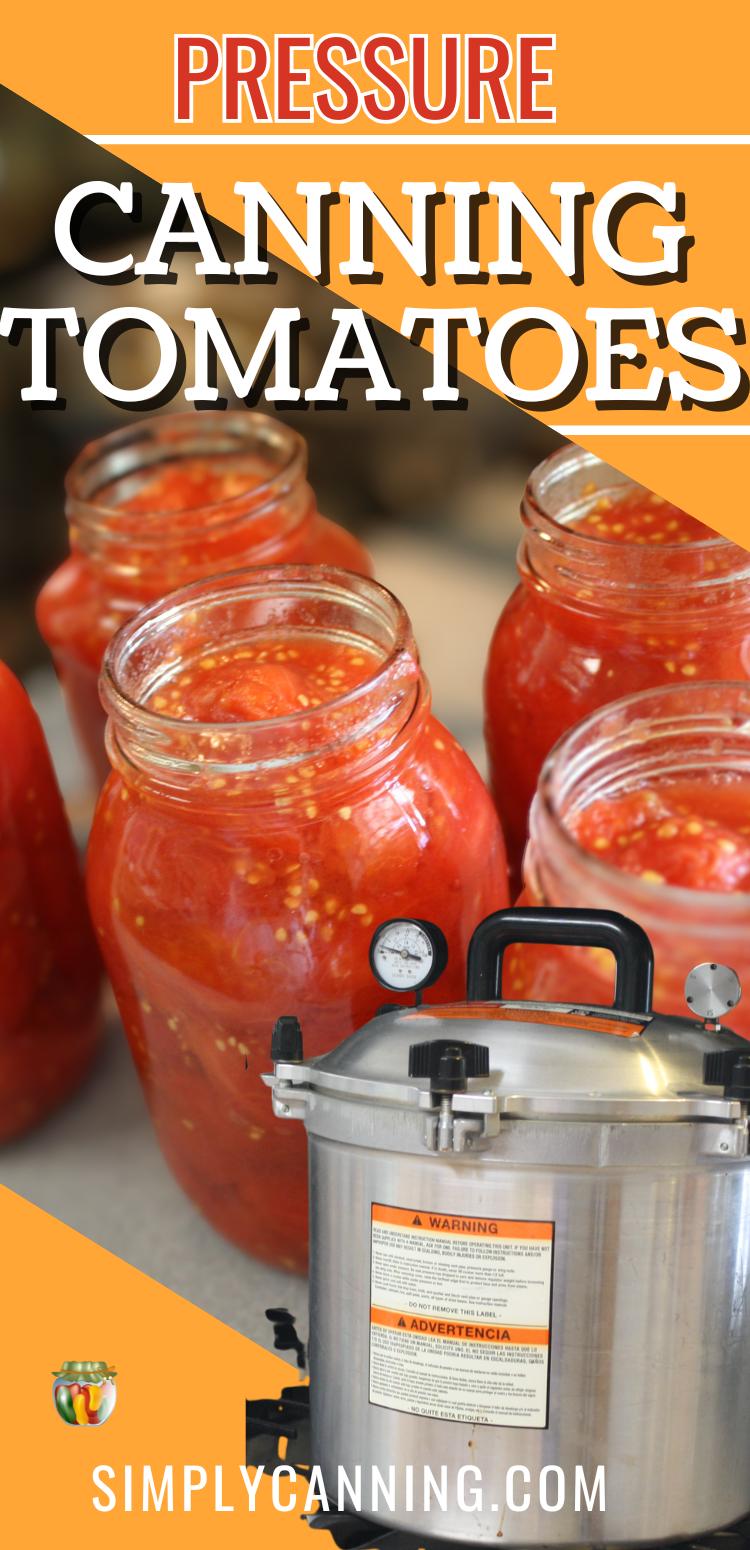
Learn how to pressure can tomatoes step by step. This is a raw pack tomatoes in it’s own juices.
Water bath canning is also suitable for raw pack tomatoes. The preparation steps are the same—they are simply processed differently. You can see water bath canning tomatoes for specifics on the water bath process here.
This post includes directions for pressure canning tomatoes.

Know your Canner
Before you start this project, please be familiar with using your canner.
This post will familiarize you with how a canner works, How to use a pressure canner . Steps to take getting set up for any canning project.
Canning tomatoes raw pack
The pressure canning recipe below is for a raw pack. This simply means you’ll pack the tomatoes in the jars raw. It does NOT mean you don’t have to process. You do have to process your tomatoes.
If you want to use a hot packing method, check out canning tomato sauce, because if you heat your tomatoes first, they’ll get saucy.
Canning Tomatoes in a pressure canner: Step by Step Directions
Supplies
- pressure canner
- canning jars
- canning lids and rings
- jar lifter and canning funnel
- large pot of water or blancher
- bowls
- large spoons
- sharp knife
- towels and dish cloths
Ingredients:
- tomatoes – I’m using Roma tomatoes on this page, but other varieties work as well.
- canning salt (optional)
- lemon juice (or citric acid)
Start by preparing your jars and getting water in your canner heating. See the canner specific directions linked above.
As your canner is heating up you can core and peel your tomatoes.
How to Blanch and Peel Tomatoes for Canning
Tomatoes should be peeled for any canning.
I’ve got a full tutorial on how to peel tomatoes on this post but the blanching basics are.
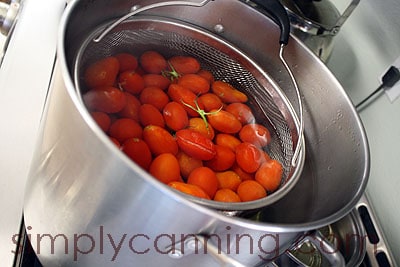
- Use a strainer or basket to dip your tomatoes in boiling water for about a minute. Sometimes a little more. Watch for the skins to split.
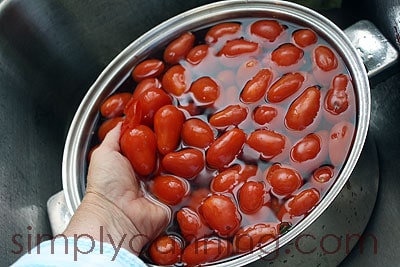
- Transfer the tomatoes to a bowl of cold or ice water to cool so you can handle them to peel.
- Slip off the skins and core the tomato. Coring just means pull off the stem and any firmer portion just below the the stem. Sometimes it all comes off with the peel. I like to use a strawberry or tomato corer similar to this one, for this step.
- Cut tomatoes to fit into jars if needed. Small tomatoes can be left whole.
- Drop the peeled tomatoes right in a jar.
In these pictures, I am working with Roma tomatoes. I like them for canning because they are meatier than other tomatoes.
Blanching Basket Options
- This is my preferred basket. It is a Polder Brand Basket.
- You can also use an inexpensive blancher like this one.
- But you can also just keep it simple and use a slotted spoon and pot of boiling water.
Do you really need to peel your tomatoes for canning?
Yes you really need to peel your tomatoes for canning. Even in a pressure canner. All current recipes and tomato methods were tested with the tomatoes peeled. If you do not peel you are changing the process and the testing doesn’t apply. Peels can hold bacteria.
Add Lemon Juice and Salt to the Canning Jars.
- Add bottled lemon juice to the jars: Use 2 Tablespoons lemon juice per quart or 1 Tablespoon lemon juice per pint.
- Add salt to your jars. 1 teaspoon of salt per quart jar or 1/2 tsp. salt per pint to the jars, if desired.
Note – It is easier if you add lemon juice and salt before you fill the jars but not required. If you forget no big deal just remove a spoonful of tomatoes if needed so the lemon juice won’t make the jar too full. Add the lemon juice and salt on top. (I’ll talk about headspace below too!)
Do you really have to add lemon juice?
You should add acidification but it doesn’t have to be lemon juice. There are other ways of adding acid to your tomatoes. Lemon juice is my choice but you might want to look at this page – How to Can Tomatoes Safely, the lemon juice debate. for some other options.
Adding acidity bumps the ph levels and makes tomatoes high acid enough for home canning. It doesn’t matter if you use a water bath or pressure canner. These recipes and processing times were tested for tomatoes with added acidity. Don’t skip this.
Do you really need to add salt to home canned tomatoes?
The good news is: No, you do not have to add salt. It is optional and for flavor only. I highly recommend it as it does add nice flavor, but if you need low sodium you can reduce or eliminate salt.
Raw Packing Tomatoes
As you peel your tomatoes, slice them in halves or quarters to fit your jars Smaller tomatoes (like my Romas) can be left whole. Place them directly into your jars as you peel them.
No water is added. Simply press down on the tomatoes until spaces between them fill with juice. This will crush them slightly. Leave 1/2-inch headspace.
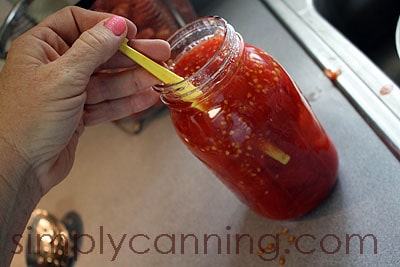
Remove air bubbles with a small utensil–I find an orange peeler works great for this step. But they do sell bubble tools for the job as well.
Wipe the rims of your jars clean before placing your lids on. If there are bits of food, it may interfere with the seal. Place lids and screw bands on the jars and place in the canner on a rack.
Remember: Have the canner water hot, but not boiling yet, when you fill it with the jars.
Don’t Add Water to the Jars
Keep in mind these are raw packed tomatoes in their own juice. You should not add water to your jars. If you add water, you change the acidity and there are different processing instructions in those circumstances.
Why are my tomatoes floating?
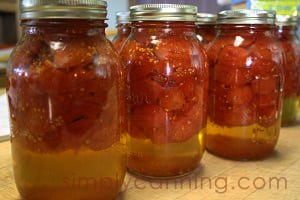
Often tomatoes end up floating at the top of the jars with all the liquid at the bottom. It is very common and not a safety problem.
I’ve got some tips on how to avoid floating when canning tomatoes here.
Processing Directions for Canning Tomatoes
Processing for a Pressure Canner
- Process both pints or quarts for 25 minutes.
(Adjust processing according to your altitude, using charts below. More information on altitude adjustments and home canning can be found here.)
Pressure Canning Tomatoes Raw Pack
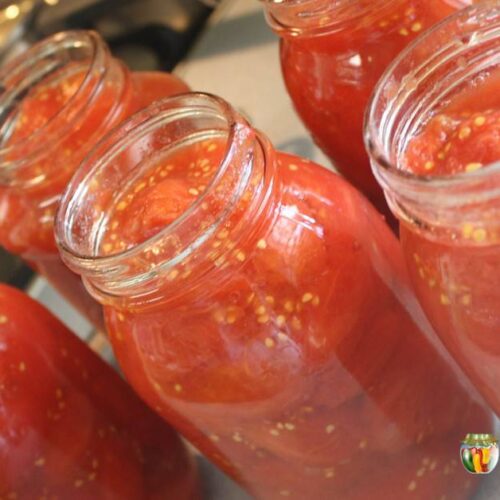
Equipment
Ingredients
- Tomatoes
- Canning Salt optional
- Lemon Juice or citric acid
Instructions
- Start by preparing jars and getting water in the canner heating. You want the canner hot, but not boiling, when the jars are ready to be processed.If you are new to using a pressure canner, see this article for full pressure canning instructions. This includes more detailed information and step-by-step instructions on how a pressure canner works.
Raw Pack only
- Peel tomatoes.
- Halve or quarter tomatoes. (You can leave small or roma tomatoes whole.)
- Add lemon juice to hot jar, 2 Tbsp. per quart or 1 Tbsp. per pint. (For citric acid, follow the directions on the package.)
- If desired, add canning salt (1 tsp. per quart or 1/2 tsp. per pint).
- Pack tomatoes into jar as you peel them, pressing down to fill space with juice.
- Leave 1/2” headspace.
- Remove air bubbles, wipe the rim clean, and place seal and ring. Place jar in the warm canner. Proceed to fill all jars. Process according to directions below.
Prepare the Canner and Jars Ahead of Time.
- Add 3 quarts of water to the pressure canner. ( a splash of vinegar helps if you’ve got very hard water)
- Place clean jars upside down in the canner to warm.
- Heat water and jars but do not bring to a boil yet.
Filling Jars
- Add peeled tomatoes to the jar. Leave 1/2 inch headspace.
- Add salt if desired. 1 tsp per quart- 1/2 tsp per pint.
- Remove air bubbles with a bubble tool. Then re-adjust headspace if needed.
- Wipe jar rims clean. Bits of salt or food particles may interfere with the seal.
- Apply lids and bands fingertip tight. Place in canner.
Process in a Pressure Canner
- See canner manual if you are not familiar with canning with a pressure canner.
- Lock canner lid and heat on high. No weights yet.
- Vent steam for 10 minutes. This is when steam is coming out of the vent pipe.
- Add weight. (check chart for proper pressure for your altitude) This is when pressure starts to build. When pressure reaches the level required start your timing.
Process for the full time:
- Process pints or quarts for 25 minutes.
- Use pressure and time appropriate for your elevation. See notes. Adjust heat as needed to maintain the proper pressure.
Cool Down:
- After processing time is finished, Turn off the heat and allow canner to cool undisturbed until it reaches zero pressure. 12 hours or overnight.
- When pressure reaches zero, remove weight. Canner will still be very hot. Wait 5 minutes.
- Open lid slightly to release some steam. Wait 5 minutes.
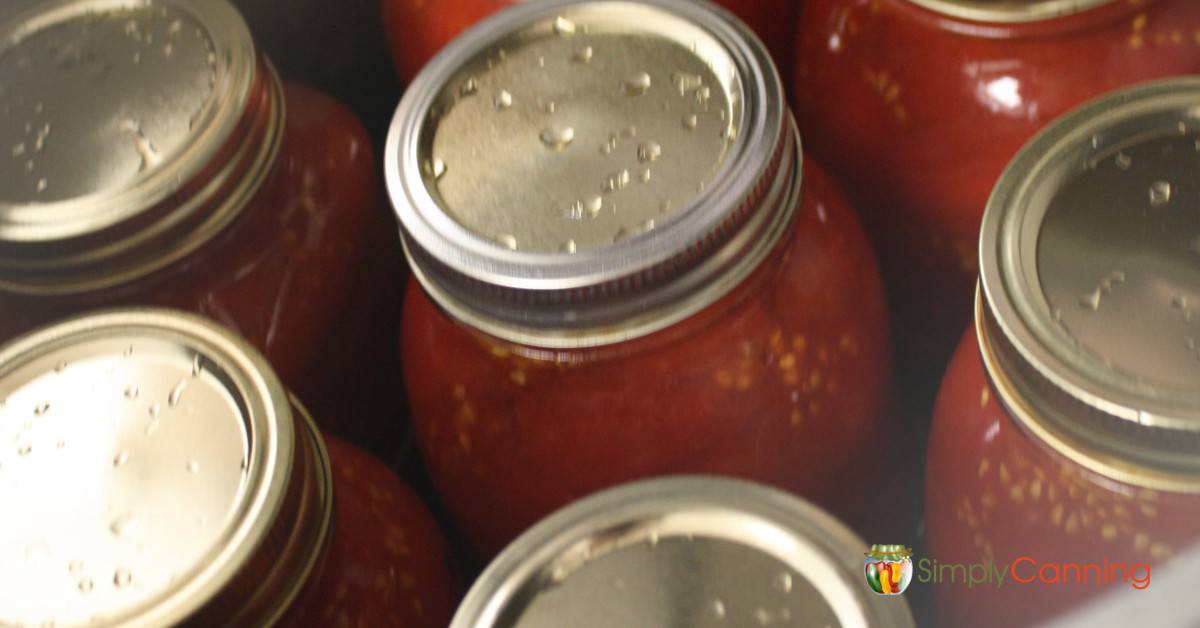
- Remove lid. Some bubbling in the jars is normal. If it is still bubbling very hard, wait a final 5 minutes. Then take jars out of canner.
- Place jars on a towel a few inches apart. Allow to cool 12–24 hours.
Check Seals and Storage
- Check seals after cooling.
- Remove bands and label jars. I suggest a date as the minimum.
- Store in a cool, dark place.
Notes
- 0-2,000 ft – 11 pounds
- 2,001 – 4,000 ft – 12 pounds
- 4,001 – 6,000 ft – 13 pounds
- 6,001 – 8,000 ft – 14 pounds
- 0-1,000 ft – 10 pounds
- 1,001 – 8,000 ft – 15 pounds
Adapted from: The National Center for Home Food Preservation
Canning Tomatoes Tips & FAQs
Yes. Do add lemon juice or some sort of acidification to your home-canned tomatoes. It all has to do with the acidity. For more information on why acidifying your tomatoes is important, please read Canning Tomatoes Safely. Get the answers to do you really need lemon juice/citric acid? What’s the big deal, anyway?
Freezing tomatoes is another great option to save them. You can even do this prior to canning them. When you thaw them out, the skins slip right off. Check out this page for more information. Information about freezing tomatoes can be found here.
This is probably normal. If the bubbles are small and not moving like they are fermenting then it is fine. If you have movement in the jar then it is possible you’ve got spoilage happening.
Yes, you are right. The jars do cool down when you add the tomatoes. They won’t be cold though. They might be sort of lukewarm or even end up at room temperature. That is why you want the water in your canner hot, but not boiling hot. It can be a bit hotter than your jars; canning jars are pretty sturdy but don’t have a drastic difference in temperature. Great question.
You really do need to process your jars of tomatoes but it doesn’t have to be a water bath. It can also be in a pressure canner. You should not do what is sometimes called “open kettle canning”. You can read more about open kettle canning here.
Oh goodness! Canned tomatoes and tomato sauce are basic in any pantry. It can be used as a base for soup or stews. You can make and can salsa but you can also open a jar of home-canned tomatoes add vinegar, peppers, onions, garlic, etc and make fresh salsa from it.
Just like regular-sized tomatoes. :). The trick is the peeling step. You can’t skip it. You’d be surprised how easily cherry tomatoes peel though. Be sure and watch close they don’t need to be blanched as long.
This will depend on what recipe you are using. Are you adding water? Are you canning whole or sauce? For this page we are packing tomatoes cut with no added water. Just in it’s own juice. Process both pints or quarts 85 minutes. (don’t forget the acidification!)
Source: The National Center for Home Food Preservation
Is doing a raw pack of tomatoes similar to making diced tomatoes? Tomatoes don’t grow super well in my area but not impossible so I would have to likely buy them in bulk to make all of the tomato products I like to use-diced, sauce, paste, and crushed. I’m trying to make a list of foods I want to can and gathering recipes for them so I can get started-and then figure out where I am going to put it all lol and is 1 pint equivalent to a 15oz can from the store?
Yes, raw pack tomatoes would be similar to diced tomatoes. Except the texture will be a bit different. but I’ve substituted my raw pack tomatoes for diced in many recipes and had no problem. And one pint is 16 oz… so it’s close. Again I’ve used a pint to replace a can of something and it works fine. 1 oz difference is pretty small.
you don’t mention the amountof water needed in the canner. Do you put the jars in and then cover them with water or do you only fill to the metal ring?
Hi Donna, Since the basic instructions on how to use a canner are the same for all foods I’ve put that on a single page with the food specifics on the recipe pages. I do have a link to that on the page but maybe I need to make it more prominent. The answers to your questions about water levels depend on the type of processing you want to do. Here are the links for you. If you want to process this in the waterbath check this page for specifics. If you want to process in a pressure canner check… Read more »
First time ever canning tomatoes. I just started canning this year, after deciding I wanted to branch out my garden to food along with flowers.
I’m pretty excited. A lot easier than I thought it would be.
PS. LOVED THE SCRIPTURE at the end of this page.
I’ve been canning tomatoes for years without removing the skins. Why? Because that part, like all fruit is where the majority of the vitamin C is. Just remove the stem and any blems. Toss ’em into a food processor and blend. Fill hot cleaned jars and can as per usual; no need for added salt. Folks outta learn how food tastes without added SOS, i.e., added salt/oil/sugar. Add a touch of citric acid depending on the size of the jar. ‘Tis unlikely humans will survive as a civilization continuing to do things the same way we’ve always have. This is… Read more »
Hi John, The reason it is recommended that you remove the skins is… that is the way it was tested. The skins may have more bacterial load than just the flesh of the fruit. Washing them cleans them… but not as much as peeling them. this is a hot debate in the canning world!
Citric acid works, I always use lemon juice just because that is what I have on hand. 🙂 Just be sure you acidify your jars.
As for salt… no problem it is perfectly safe to leave it out.
I have canned tomatoes without removing the skins, with excellent results. This practise was not tested as the skins can be undesirable to consume,. With domestic kitchens able to use food processors to break the skins down into small pieces, it has become aesthetically feasible to include the skins when canning tomatoes. Tomato skins have good nutritional value. Personally, since items like cherries have been tested and can be canned safely with the skins on, it seems unlikely that tomatoes would be all that different. Since we can bushels and bushels of tomatoes, we are going to start using a… Read more »
Thanks for sharing. I checked out the document you included and found it interesting. It looks to me like someone who is asking for the research to be done on canning with tomato skins. I do hope they fund this and do the testing! It would be reassuring. I do still recommend taking the skins off.
What do I do with the water, in the raw method, when ready to use the tomatoes? Thanks for the video, I’ve got a ton of tomatoes this year!
Do you mean the liquid in the jars of tomatoes? It really just depends on how you’re using the end product. You could drain it off, reserving the liquid to add to soup or something like that. Or if you’re making sauce, you might just blend the tomatoes with the juice, etc. It just depends. 🙂
-Rachel (Sharon’s assistant)
Can I pour off some of the tomato juices before canning?
No with these directions. The juices from the tomatoes will fill up the jar. You don’t pour any off.